Trade Dress in the Ice Cream Aisle: $23.785 Million Disgorgement Award Bolsters Brand Owner Rights in Product Packaging
A packaging design can qualify as protectable trade dress—even when built from individually simple elements—if the combination creates a distinctive overall commercial impression. In Van Leeuwen Ice Cream LLC v. Rebel Creamery LLC, 2026 WL 2056314 (E.D.N.Y. July 16, 2026), the United States District Court for the Eastern District of New York held that Rebel Creamery LLC’s minimalist ice cream packaging infringed and diluted Van Leeuwen Ice Cream LLC’s trade dress, ordered a full packaging redesign, and awarded $23.785 million in disgorged profits. This decision offers concrete guidance for brand owners and companies launching competing products on four fronts: defining trade dress precisely; building and preserving the design record; responding to marketplace warnings; and quantifying damages exposure early.
The Dispute
Van Leeuwen Ice Cream LLC (“Van Leeuwen”), a premium dairy ice cream brand, redesigned its product packaging in 2016 and defined the resulting trade dress as four key elements: (1) monochromatic cardboard pints with matching monochromatic lids; (2) a primarily pastel color palette; (3) black script typeface lettering with an exaggerated capital letter across the front of the pint; and (4) an overall minimalist design aesthetic. The redesign was commercially successful: Van Leeuwen’s annual growth rate essentially doubled after the rebrand, and the packaging received widespread acclaim in design publications and industry media.
Rebel Creamery LLC (“Rebel”), founded by Austin and Courtney Archibald in 2017, sells keto-friendly ice cream. Although the Archibalds testified that they had never seen Van Leeuwen ice cream while developing Rebel’s packaging, Rebel launched products featuring pastel-colored monochromatic pints, black cursive script with an exaggerated initial capital letter, and a minimalist overall design.
Van Leeuwen sued in April 2021, asserting federal trade dress infringement, reverse confusion, common-law infringement and unfair competition, and New York trademark dilution.
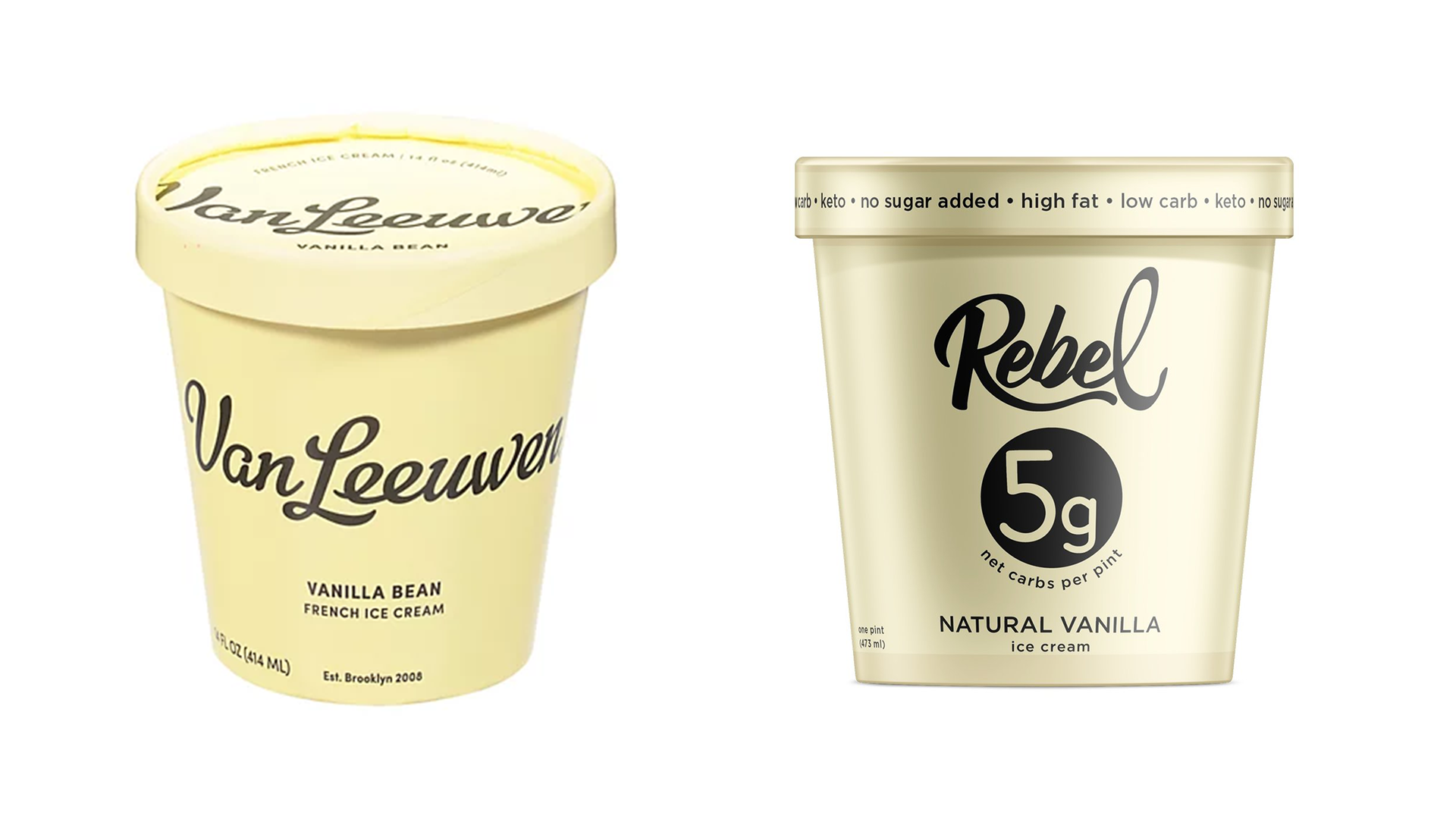
Image on the left is an example of Van Leeuwen’s trade dress, and the image on the right is an example of Rebel’s packaging. Both images were sourced from the District Court’s published opinion.
The Court’s Decision
The court ruled for Van Leeuwen on all claims. Its reasoning offers a practical roadmap for companies that develop, refresh, or clear consumer-product packaging:
Define the design with objective guardrails. The court found Van Leeuwen’s four-element trade dress definition sufficiently precise. It rejected the argument that terms like “primarily pastel” and “minimalist design aesthetic” were impermissibly subjective, noting that Rebel’s own founders testified to “choosing pastel colors” and that minimalism can be measured by the proportion of negative space to design elements.
Consistency should be built into product-line strategy. The court found a “consistent overall look” across Van Leeuwen’s 37-flavor “classic dairy line,” even though a few pints used non-pastel colors (one was acknowledged as a “mistake” and quickly corrected). The limited-edition line—which used different color schemes—could not defeat consistency because it was a separate, defined product line.
Ordinary features can be distinctive in combination. The trade dress was inherently distinctive because it was arbitrary—selected from an “unbounded universe of options.” Packaging need not be monochromatic; pastels are only a subset of the color wheel; cardboard is uncommon when plastic dominates; and minimalism departs from the visually dense norms of the category. Unsolicited press acclaim reinforced that conclusion.
Minimalist design and pastel colors were not functional. The court rejected Rebel’s functionality defense: most ice cream brands communicate effectively without minimalist design, and many use non-pastel packaging.
Similarity, channel overlap, and confusion drove liability. Six of eight Polaroid factors favored Van Leeuwen. The trade dress was strong (supported by advertising, media coverage, and sales); the containers were “strikingly” similar, with Rebel deploying all four claimed elements; the products competed on the same shelves; and survey evidence showed a 34.3% net confusion rate—well above the 15% threshold courts generally consider sufficient.
Design records and marketplace warnings mattered. The court called the Archibalds’ claim of independent creation “clearly fabricated,” citing the “infinitesimal” probability of convergence on so many identical features, the absence of any iterative design files, and a retail buyer’s warning that Austin Archibald ignored.
The “good-faith remote user” defense is narrow. The court rejected this defense because Van Leeuwen was already sold in Rebel’s launch market (Los Angeles), and Rebel acted in bad faith.
Remedies can reach total product profits. The court awarded $23.785 million—two-thirds of Rebel’s $35.5 million in total profits—after applying a 33% equitable reduction for sales driven by the keto trend, rather than packaging confusion. Critically, Rebel failed to offer a reliable apportionment method, so the court made its own reduction based on customer-overlap data.
Practical Takeaways
For brand owners, in-house counsel, and product teams:
- Packaging choices can create protectable rights. A combination of ordinary-looking features may be inherently distinctive when it represents an arbitrary, non-functional departure from industry norms. Document the alternatives considered and assess features together—not one at a time.
- Define trade-dress elements precisely. Describe a claimed look through observable, repeatable features that can be applied consistently across a product line. Subjective terms like “minimalist” can survive challenge if they are tied to measurable criteria.
- Preserve the design record. Retain mood boards, drafts, agency communications, and decision rationale. In this case, the absence of iterative design work supported a bad-faith finding and weakened the independent-creation narrative.
- Act on marketplace warnings. If a retailer, consumer, or counsel flags potential trade dress overlap, assess the concern promptly and document the response. Ignoring a warning—as Rebel did when a buyer flagged the similarity—was treated as evidence of bad faith.
- Prepare for functionality challenges. Companies relying on packaging as a source identifier should be prepared to show that their aesthetic choices are not required to compete effectively in the category.
- Quantify damages exposure early. The $23.785 million award shows the risk when an infringer cannot reliably apportion sales to non-infringing factors. Assess resolution economics early and determine whether your product, customer, and sales data can support a defensible allocation.
- Define the product line strategically. Establish which products carry the claimed trade dress and exclude non-conforming items (e.g., limited editions, co-brands). Document that segmentation so it is available if consistency is later challenged.
- Evaluate packaging in real market conditions. Packaging clearance should examine the full market context—including channel overlap, consumer confusion risk, and competitive shelving—not only side-by-side design differences in a conference room.
- Clear trade dress before entering a new market. The good-faith remote-user defense failed here because the senior user was already present in the launch geography. New-market launches should include trade dress clearance—not just trademark searches—against the packaging actually on shelves in the target channels.