THE ABCs OF CREDIT AGREEMENT WATERFALLS
This is the first in a two-part series on waterfalls in syndicated and private credit transactions. This Legal Update explains how waterfalls allocate value in a single syndicated facility. The subsequent installment will address multi-creditor structures, recent market developments and key practice considerations.
Executive Summary
In corporate loan agreements, a waterfall provision – often called a “priority of payments” clause – specifies the order in which incoming payments or proceeds are applied to outstanding obligations. In this Legal Update, we examine the mechanics of waterfall provisions under US law, including a typical waterfall structure, application mechanics in ordinary course and default scenarios, and a checklist for lenders reviewing waterfall language.
Why Waterfalls Matter
In stress scenarios, where available proceeds may not cover all obligations, waterfalls determine payment priority and allocate losses among creditors. A lender’s position in the waterfall and the tier to which payments are applied directly affect its recovery. Understanding these mechanics is key to assessing credit risk and anticipating recovery outcomes.
What is a Typical Waterfall?
- First Priority: Administrative Agent Fees, Costs, and Expenses. The top of the waterfall is reserved for the administrative agent’s fees, costs, and expenses, including enforcement costs and protective advances. These claims rank ahead of all others, including lender fees, because the agent acts for the benefit of the entire lender group by administering the facility, enforcing remedies, and advancing funds to preserve and realize on the collateral (such as paying insurance premiums or property taxes).
- Second Priority: Lender Fees and Expenses. Next are fees and expenses owed to lenders and other secured parties, such as letter-of-credit fees, commitment fees, and prepayment breakage costs. Like the agent’s expenses, these outrank interest payments because lenders should be made whole for their costs of administering and collecting the credit before economic returns (i.e., interest and principal) are distributed.
- Third Priority: Accrued Interest (including Default Interest) and Other Financing Charges. After fees and expenses, payments are applied to accrued interest, including ordinary and default interest. Interest ranks ahead of principal on the theory that lenders should be compensated for the time their principal was at risk. Junior creditors may seek to cap or subordinate default, compounded or post-petition interest, particularly in intercreditor or bankruptcy contexts.
- Fourth Priority: Outstanding Principal Payments. Remaining funds then reduce outstanding principal, returning capital and reducing credit exposure. The collateral package may also protect other obligations, but they are often ancillary, contingent, or owed only to specific parties. The agreement will specify how principal payments are allocated among the applicable loans, such as whether they are allocated to the scheduled installment due or for an insufficient lump-sum payment among the applicable loans on a pro rata basis.
- Fifth Priority: Other Secured Obligations. A credit facility may secure obligations beyond the underlying loans. Other secured obligations, such as hedging, treasury management, cash management or other lender-affiliate obligations, are sometimes pari passu with the principal but often rank behind principal and share only after the loans are repaid.
- Sixth Priority: All Other Obligations. The final tier is a catch-all for any remaining amounts owed under the loan documents, such as indemnity claims, increased cost amounts, tax gross-up obligations, judgment amounts, or other secured obligations not previously addressed.
- Seventh Priority: Any Surplus to the Borrower or Other Party Legally Entitled to Funds. After all secured obligations are paid in full, any surplus proceeds are returned to the borrower or to another party legally entitled to them, such as a junior lienholder.
When Do Waterfalls Apply?
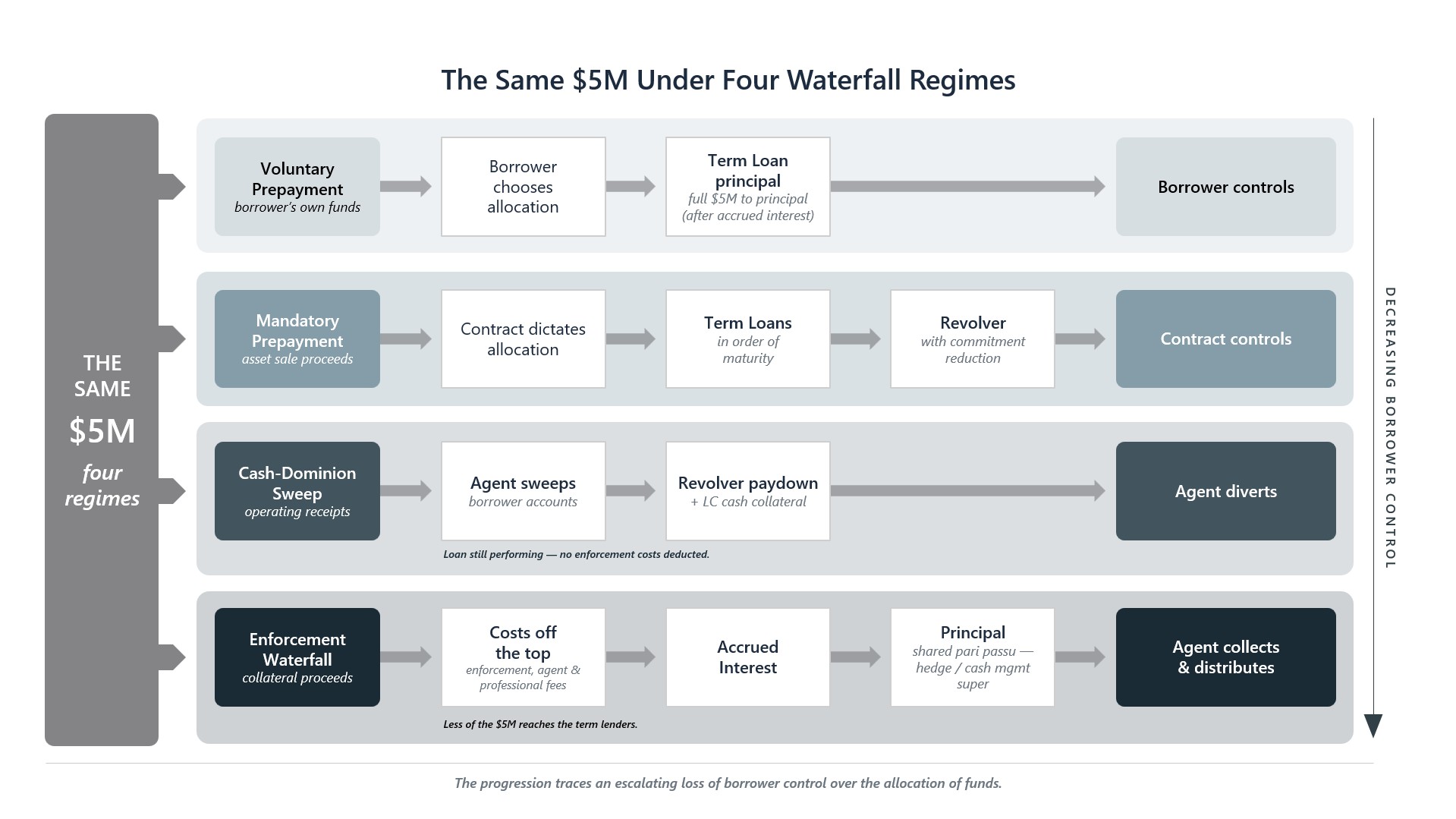
The payments stack described above is the default priority rule, but its operation depends on the context. Each scenario can route the same funds to different creditors. Four examples, in order of escalating distress, are voluntary prepayments, mandatory prepayments, account sweep and cash-control, and post-default and enforcement.
- Voluntary Prepayment Application: When a borrower elects to prepay ahead of schedule, the credit agreement may specify how the payment is applied. In a single-tranche facility, this is simple—the prepayment reduces principal, with accrued interest paid as part of the prepayment transaction. In a multi-tranche facility, allocation is key: may the borrower choose which tranche to pay down, or must it follow a required order? Many agreements allow some discretion, and a borrower will rationally direct prepayments to its least favorable debt—often the revolver, which it can re-draw. Lenders may resist this by insisting voluntary prepayments go to term debt unless the commitment is also reduced.
- Mandatory Prepayment Application: Mandatory prepayments arise from specified events, such as asset sales, casualty or condemnation recoveries, and excess-cash-flow sweeps. In these situations, the credit agreement dictates how the funds are applied. Proceeds typically go first to the term loans and then to the revolver, sometimes with a permanent reduction in revolving commitments, though the allocation varies by facility, tranche and triggering event. Lender decline rights may further complicate that allocation. For instance, a term lender may elect not to receive its share of certain mandatory prepayments, and the agreement must specify whether the declined amount is reoffered to other term lenders, applied to the revolver (if any) or retained by the borrower. Any mandatory prepayment applied to term loans must then be allocated against the remaining scheduled amortization installments—whether in direct order of maturity, inverse order or ratably. Lenders should be aware that this waterfall is less a fixed rule than a negotiated formula—reinvestment rights, the defined “net proceeds” amount, decline rights, and similar carve-outs commonly reduce how much actually reaches it, so a mandatory prepayment often retires less debt than the headline trigger suggests.
- Account Sweep and Cash-Control Application: Some secured facilities sweep cash from borrower-controlled accounts into agent-controlled accounts. Unlike the other contexts discussed here, this is usually not a separate order of application. Rather, when cash comes under the agent's control, the credit agreement's ordinary payment-application provisions govern how it is applied. When negotiating and drafting transaction documents, lenders should ensure alignment so that account control, sweep triggers, and the payment waterfall work together so that payments are applied in the intended order.
- Post-Default and Enforcement Application: After a default, the application shifts from applying ongoing payments among performing loans to distributing a finite pool of recovery proceeds among secured claimants. Two things matter most. First, the distribution pool should include liquidation proceeds, guaranty payments, and bankruptcy distributions, rather than scheduled payments. Second, the waterfall should establish who shares it, including whether hedge counterparties, cash management banks, or other creditors participate pari passu alongside the lenders, or whether the proceeds are reserved for the loans first, with the ancillary products such as the foregoing being paid after the loans. Within each tier, claimants share ratably, so no lender can jump ahead of a similarly situated creditor unless the documents say otherwise.
To illustrate these four scenarios, consider that a company with a term loan and a revolver has $5 million to distribute. The graphic below shows how the same dollars move differently under each regime:
A related but distinct waterfall appears in the “Defaulting Lenders” section of the credit agreement, which is often the only provision to use the word “waterfall” expressly. It does not conflict with the others because it operates one step downstream: the primary waterfall runs first, fixing each lender's entitlement, and the defaulting lender waterfall then intercepts only the share allocable to a “Defaulting Lender,” reapplying it in a specified order. Since this waterfall responds to a lender's default, not the borrower's, it can impact recoveries while a loan is fully performing.
Application in Fund Finance and Private Credit
In a subscription credit facility, the waterfall applies to proceeds from capital calls made upon investors. Upon an event of default, the lender may call capital from investors directly and apply the funds according to the waterfall. Lenders should confirm that the callable capital supporting availability aligns with the borrowing-base construct and with any excuse or exclusion rights in investor documentation.
In NAV or hybrid facilities, the waterfall governs the application of portfolio distributions. Upon a loan-to-value (LTV) or coverage-ratio trigger, the funds are diverted into a controlled account. If the collateral package is limited to distribution rights and pledged accounts, the waterfall becomes the lender’s primary recovery path, making precise drafting and consistency with the account control arrangements essential. Lenders should focus on diversion triggers, the carve-outs that survive diversion (management fees or tax distributions), and the treatment of permitted distributions during any cure period.
In private credit portfolio back-leverage facilities, collections on the underlying loan assets are typically deposited into controlled accounts and distributed on scheduled payment dates through a negotiated waterfall. Upon a default or acceleration, the structure may shift to a more restrictive default waterfall that redirects available cash to senior obligations before paying any junior or residual claims.
Lender Checklist: Assessing the Waterfall
Given the complexity and importance of waterfall provisions, lenders and their counsel should rigorously review these clauses. The following is a sample checklist for that review:
- Check the Payment Stack. Confirm that agent fees and enforcement costs, lender fees and expenses, accrued interest, principal, other secured obligations, and residual obligations are sequenced as intended.
- Test the Prepayment Mechanics. Confirm how voluntary prepayments are applied—including, in multi-tranche facilities, whether the borrower may choose the tranche, and whether a revolver paydown must reduce commitments—and review the mandatory prepayment triggers, “net proceeds” definition, reinvestment rights, and carve-outs.
- Align Cash-Control and Sweep Mechanics. Trace a swept dollar end to end: confirm the sweep trigger, the controlled-account/control-agreement mechanics, and the payment waterfall all connect, so that cash moves into the agent's control and is applied in the intended order.
- Model a Downside Scenario. Simulate at least one post-default scenario showing how collateral proceeds, guaranty payments, or bankruptcy distributions would be applied after a default, including which claims must be satisfied before any value reaches the lenders.
- Check Who Shares in Each Tier. Confirm whether hedge providers, cash management banks, letter-of-credit issuers, and other secured parties participate, and whether similarly situated parties share ratably within a single tier.
- Check Consistency Across Documents. Compare the credit agreement, security agreement, and any intercreditor or subordination agreement to align the definitions of “Obligations” or “Senior Secured Obligations” and the payment-application provisions.
Conclusion
Waterfalls determine payment priority when claims compete, and their order matters most after default. Ensuring these provisions are correct at origination and consistent across credit, security, and intercreditor documents is one of a lender's most effective forms of credit protection.