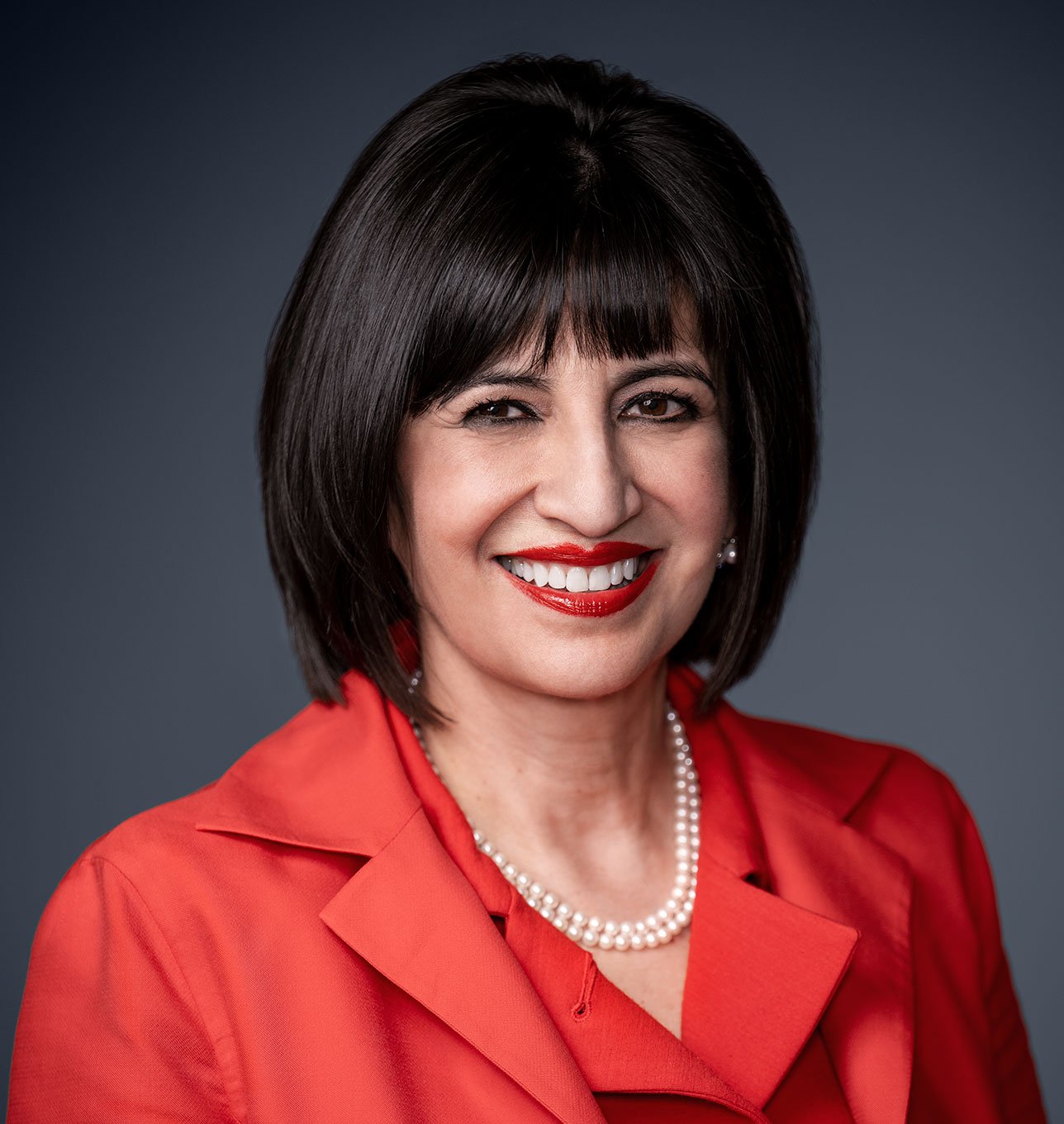
A Life Shaped by Global Perspective and UVA Values
Q&A with Elizabeth Espín Stern
Elizabeth Espín Stern (College ‘83, School of Law ‘86) has built an impressive career bridging law and global engagement. The daughter of an Ecuadorian diplomat, she grew up surrounded by international perspectives that she channeled into a B.A. in political science and a minor in French, followed by a law degree. Her experiences inspired her to found and lead Mayer Brown’s Global Mobility & Migration practice, where she continues to advise today. Deeply connected to UVA as both an alumna and a parent, she remains an active member of the University’s global community through her service and philanthropy. In this conversation, Stern reflects on her time at UVA, her global journey, and her latest pursuits, including two forthcoming books: one on women’s leadership and another, a mystery with UVA ties.
What were some of the highlights of your time at UVA as a student and, later, as a UVA parent? How did these experiences shape your path toward law and, ultimately, your focus on immigration?
Stern: What captivated me about UVA was the sense of being part of a holistic community motivated by a universal set of values – academic excellence, continual discovery, and individual development. I met students of different backgrounds, with different skills and attributes, but we all shared a common interest in learning everything we could about complex and challenging subjects. And there was such a wealth of subjects to choose from. I vividly remember the passionate lecture one of my history professors gave on the Peloponnesian War, but it was equally interesting to be exposed, for the first time in my case, to microeconomic theories, political campaigns (Professor Larry Sabato took us to campaign headquarters in November on election night!), and behavioral psychology (Professor Bice was a bit of a legend). The fact that both of my sons also went to UVA is especially gratifying to me as a parent because I knew, firsthand, how authentic their academic experience would be.
As to how my collegiate experience led me to law, I was an American Government major with a minor in French, so I met faculty and students with like interests in regulatory, legislative, and judicial processes, as well as those inherently interested in a cross-cultural ethos. But it was two specific experiences that cemented my path to law school. The first is that my dean, the late Charles Vandersee, who led the Echols Scholars Program when I was there, supported my aspiration to spend a semester on Capitol Hill. I clerked for Ron Dellums, who was Chair of the House Armed Services Committee, in the spring of my second year. I was fascinated by the legislative process, and became intrigued to learn more about lawmaking and statesmanship. That led to the second experience, taking Professor Henry Abraham’s Constitutional Law course, an undergraduate course. The rule of law is central to any civilized society, and I was determined to do my part to contribute to the development of our American legal regime. My law school application followed not long after, and I’m delighted I could go to UVA Law and earn my status as a double Hoo.
You grew up as the child of an Ecuadorian diplomat in the United States. How has that international upbringing influenced your worldview and your work as an immigration attorney?
Stern: I grew up accustomed to having a multitude of cultures surrounding me, including not only my family in Quito, but the many diplomats and their families in DC who were part of the Organization of American States, where my father worked. Little did I know that going to embassy parties where people spoke in different dialects, recounted stories of vastly distinct but equally rich backgrounds, and welcomed one another with ease was at all unusual.
When I started practicing law, I asked my firm to include assignments in my portfolio that would allow me to use my languages and apply my knowledge of cross-cultural assimilation. Immigration, which was a burgeoning field in DC as its tech corridor entrepreneurs sought the best and brightest talent from across global regions, attracted me. These entrepreneurs taught me early in my career that inclusion of versatile talent with varying combinations of skills and aptitudes is essential to innovation and product development.
As I became a more experienced practitioner and leader in my law firms, my conviction that cultural, generational, and behavioral diversity enhances the strength of enterprises was cemented. I have had the privilege of working with some of the most innovative companies in a variety of industries, and there is none that succeeded with a homogenous talent base. The medley makes the magic, just as it did in those embassy salons of my childhood.
Over your career, what have been some of the most meaningful or satisfying moments or successes?
Stern: I love the game-changing moments. The moments where it becomes clear the market or the environment is changing dramatically, and navigating it will require genuinely novel thinking. Those moments require a leader to assemble a team of superlative talent: thoughtful people who are willing to take the risk of doing things in previously untested ways.
For example, I recall a moment 20 years ago, when I realized that a purely inbound, US immigration practice would not suffice to address the dynamic global growth of major industry. Working with a global firm with immigration practitioners across the globe, I started spending significant time abroad, particularly in London and Paris, and deployed one of our rising stars to Hong Kong (that rising star runs our practice at Mayer Brown today!). Within only two years, we attained the top ranking of one of the leading global legal directories. A decade later, at Mayer Brown, I led the initiative to develop a Global People Solution™, a prototype for global compliance across the people disciplines affecting migration – immigration, employment, regulatory, and investigations. Once again, success depended on the thoughtful, diligent efforts of a group of talented people. I will always be grateful for their commitment and friendship.
You’re currently working on two books. What inspired you to write these stories, and what can readers expect from them?
Stern: I’m working on a book on women in leadership, Woman in the Room. Both in my own leadership journey and in those I have observed, I see women changing the dynamics of decision-making to compel connectivity and curiosity. Women won’t typically accede to power-based, mandatory decisions if they feel others have not yet been heard. They infuse a relational paradigm that is healthy and, increasingly, necessary, as institutional deference is declining among newer generations. I would like to celebrate and unveil the valuable impact of these female icons.
My second book is a novel, Summer of Change. I started writing it the summer I retired from full-time practice. I could not resist a creative endeavor in writing − a longstanding passion of mine. The novel tells the story of various women and their families living in Bethany Beach, Delaware, where I spent that summer and expect to spend many more. My objective is to bring Bethany Beach to life, showcasing the culinary, artistic, and communal elements. But I included a mysterious murder that ties in UVA. The murder instigates self reflection for many of the characters, as well as, for some, renewed life decisions that affirm faith and values.
You continue to be deeply involved with UVA as part of our Global Corps of Ambassadors and through your philanthropic support. What impact do you hope your engagement will have for students and the university community?
Stern: As the next generation of leaders across disciplines, graduates of the university will need to tackle our most complex societal issues: national security, technological development and data security, infrastructure and environmental sustainability, financial stability, immigration agility, and human rights, to name only a few. To be effective, they will need not only a superb academic education, which UVA offers, but an understanding of the different cultural and geopolitical trends that impact the advancement of solutions for such complex issues. Global experiences, including study abroad, international travel, and engagement with visiting foreign students and faculty, provide inimitable insights into how other cultures think and what they value, perceptions that are essential to development of meaningful progress in any of these areas.
As part of the Global Corps of Ambassadors, I consider it part of my mission to carry this message to the student population, both generally and, through mentorship and sponsorship, on an individual level. Similarly, I look forward to helping the Global Corps, Ambassador Mull, and the university’s leadership and management plot the course for the next series of global citizenship initiatives for the university’s students.
What advice would you give to current UVA students who want to build globally engaged careers?
Stern: I applaud these students for looking for global engagement from the early stages of their careers. My advice includes three guidelines. First, rely on trusted advisors who can counsel you as you undertake new experiences. Faculty and alumni can provide invaluable insights on how to identify and optimize great opportunities at every stage. This includes study abroad, which will benefit from the guidance of predecessors in the program, as well as Ambassador Mull and his staff leaders. Second, work with the University’s career office, which has extensive connections, including for public sector and nonprofit opportunities for international experience. Third, start building a network of connections now, of individuals with varied backgrounds. Global careers are not always precisely defined, and your network, alongside your trusted advisors and the university careers office, can help demystify openings and educate you on what a global career really entails. The input of all three sources will make it easier for you to assess direction and make informed decisions along the way.