Day-1 Preferred Equity for Horizontal Rated Note Feeders
Executive Summary
The standard Day-1 Equity commitment structure works well for vertical strip rated note feeders (“RNFs”), but it can disrupt the negotiated tranche waterfall in horizontal strip structures. This Legal Update proposes a preferred equity alternative that preserves investor priority, maintains ratings neutrality, and provides lenders with an enforceable, borrowing base-eligible commitment (“Day-1 Pref”).
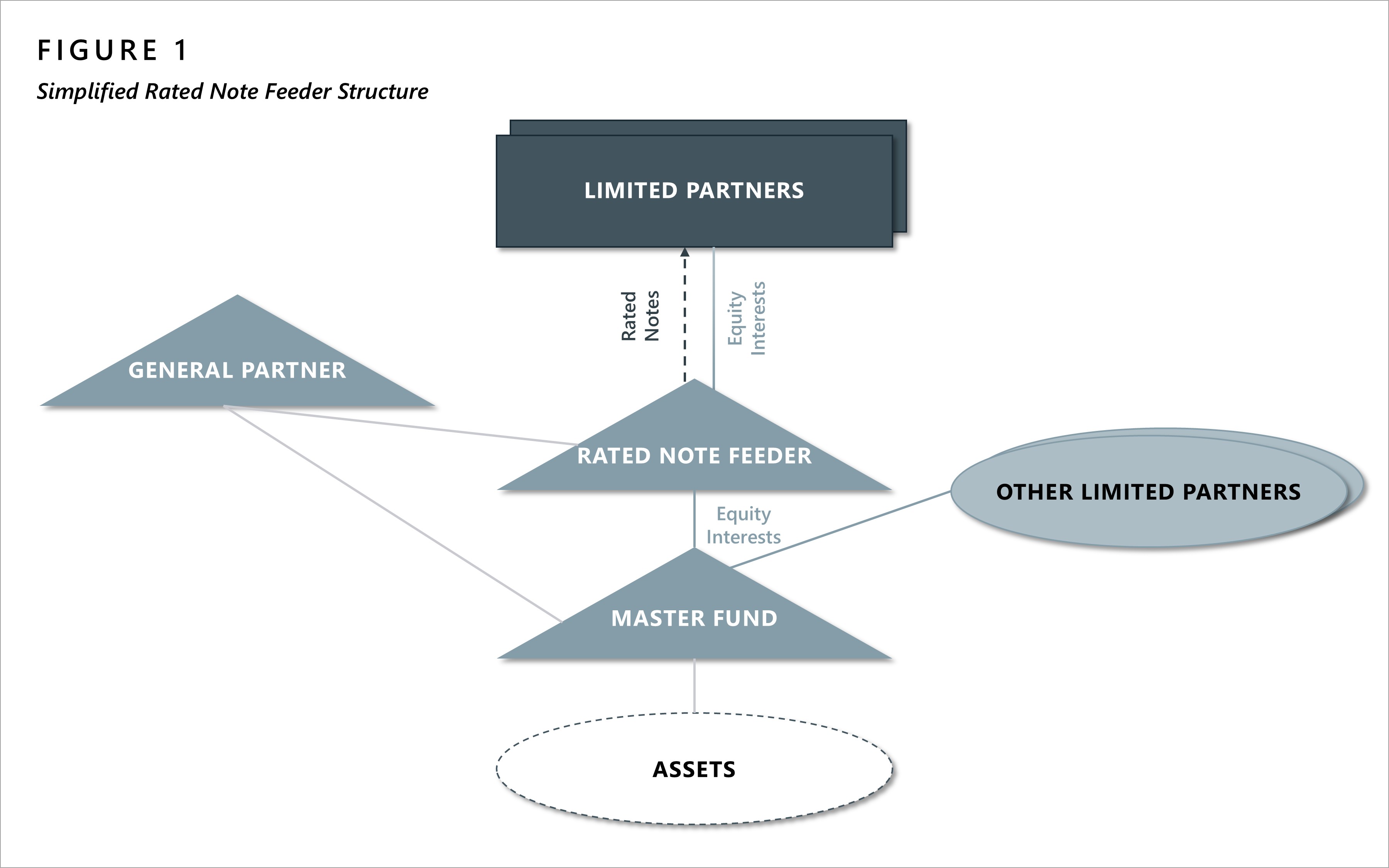
To ground the overarching issue of this Legal Update, Figure 1 sets forth a simplified rated note feeder structure.
Day-1 Equity, Revisited
Our June 2022 Legal Update, Subscription Finance: Rated Note Feeder Funds and Debt Capital Commitments, introduced the Day-1 equity capital commitment (“Day-1 Equity”), which has since become the market approach to limiting the potential risk posed by U.S. Bankruptcy Code Section 365(c)(2) in the context of RNF subscription facilities. Section 365(c)(2) prohibits a debtor from, among other things, assuming or assigning an executory contract that would require an investor to make a loan or extend credit to a debtor under a pre-bankruptcy contract. A related provision, Section 365(e)(1), renders ineffective so-called ipso facto clauses that purport to modify or terminate a debtor’s contractual rights solely because of bankruptcy or insolvency. Both provisions are relevant to the Day-1 Equity analysis.
Because an equity contribution obligation is neither a loan nor an extension of credit, a capital commitment arguably falls outside Section 365(c)(2). Although Section 365(c)(2) also addresses contracts that extend “other debt financing or financial accommodations,” courts have generally construed that catch-all narrowly, limiting it to obligations that are in substance extensions of credit. Critically, courts distinguish between contracts whose purpose is to provide financing—which fall within Section 365(c)(2) and related provisions—and contracts that establish a business relationship where any financing is merely incidental to the relationship.
Because Day-1 Equity is fully subscribed at inception (i.e., on “Day 1” of the investor’s subscription to the RNF)—rather than springing into existence upon a bankruptcy or default trigger—it does not present the ipso facto concern that Section 365(e)(1) addresses, nor is it the type of loan or financial accommodation that an investor could terminate under the Section 365(e)(2)(B) exception. On both counts, the structure mirrors the types of obligations that courts have enforced despite attempts to invoke Section 365(c)(2).
With Day-1 Equity, the investor unconditionally and irrevocably subscribes on Day 1 to two separate commitments—a debt commitment and an equity commitment—that the fund or lender may call as debt under a note purchase agreement or as equity under a traditional capital call to the RNF. This is not duplicative because the amount funded under either commitment reduces the amount available to be called under the other commitment on a dollar-for-dollar basis. It is this inception-based structure that distinguishes Day-1 Equity from conversion-style hybrid commitments, which are vulnerable to an ipso facto challenge.
Why the Standard Model Works in a Vertical Strip
Day-1 Equity works cleanly in a vertical strip RNF, where each investor holds a proportional share of every tranche of debt and equity issued by the RNF. Both equity and debt commitments are called and funded on the same pro rata basis, so calling capital as equity rather than as a note purchase produces the same economic result for each investor. The investor’s risk position remains unchanged whether the investment is funded as equity or debt (though the regulatory capital treatment of the funded amounts would differ). Figure 2 illustrates this architecture.
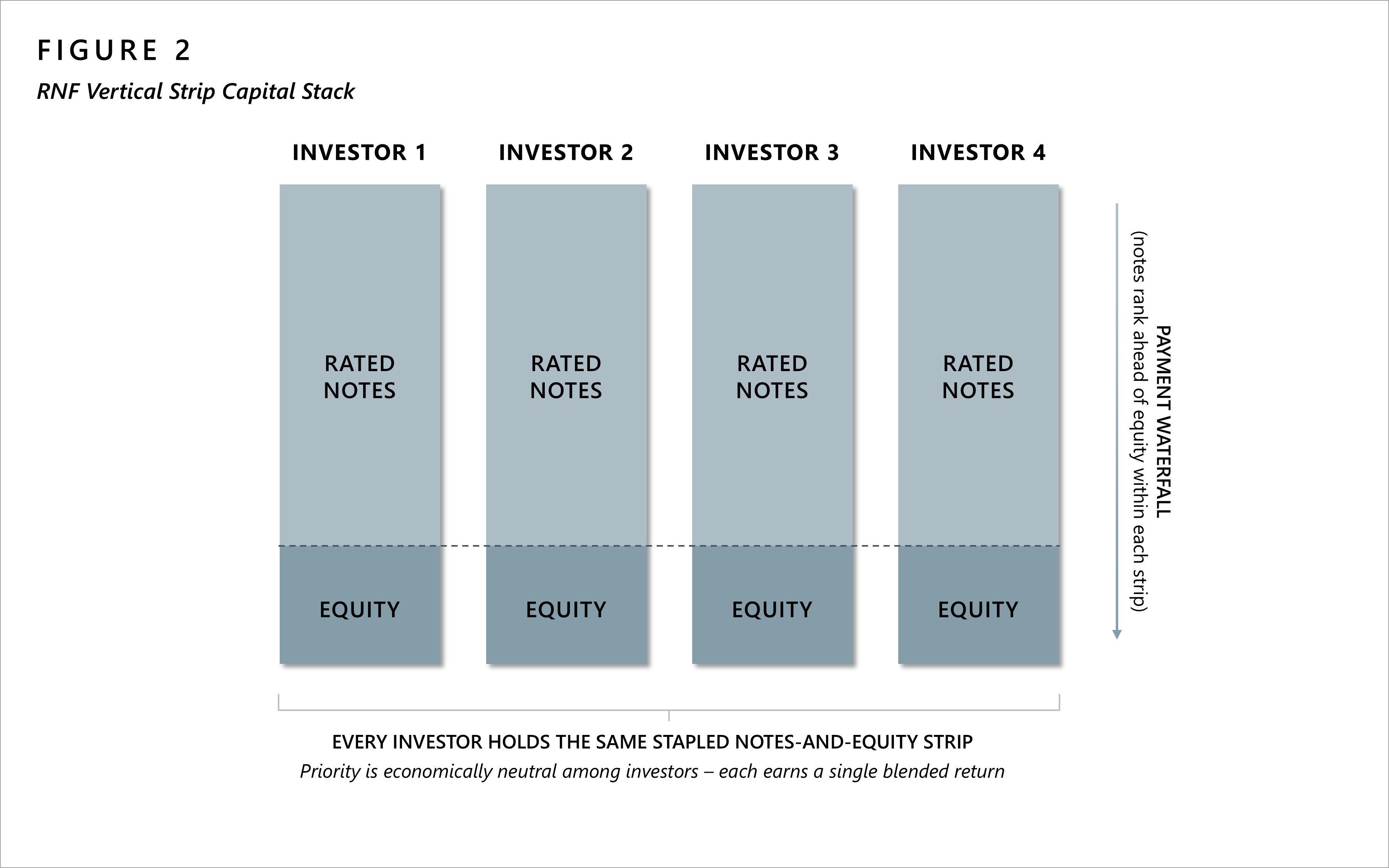
That economic neutrality makes the standard Day-1 Equity model effective in the vertical context, as it addresses the Bankruptcy Code concern without altering the agreement among investors.
Where the Horizontal Strip Breaks the Model
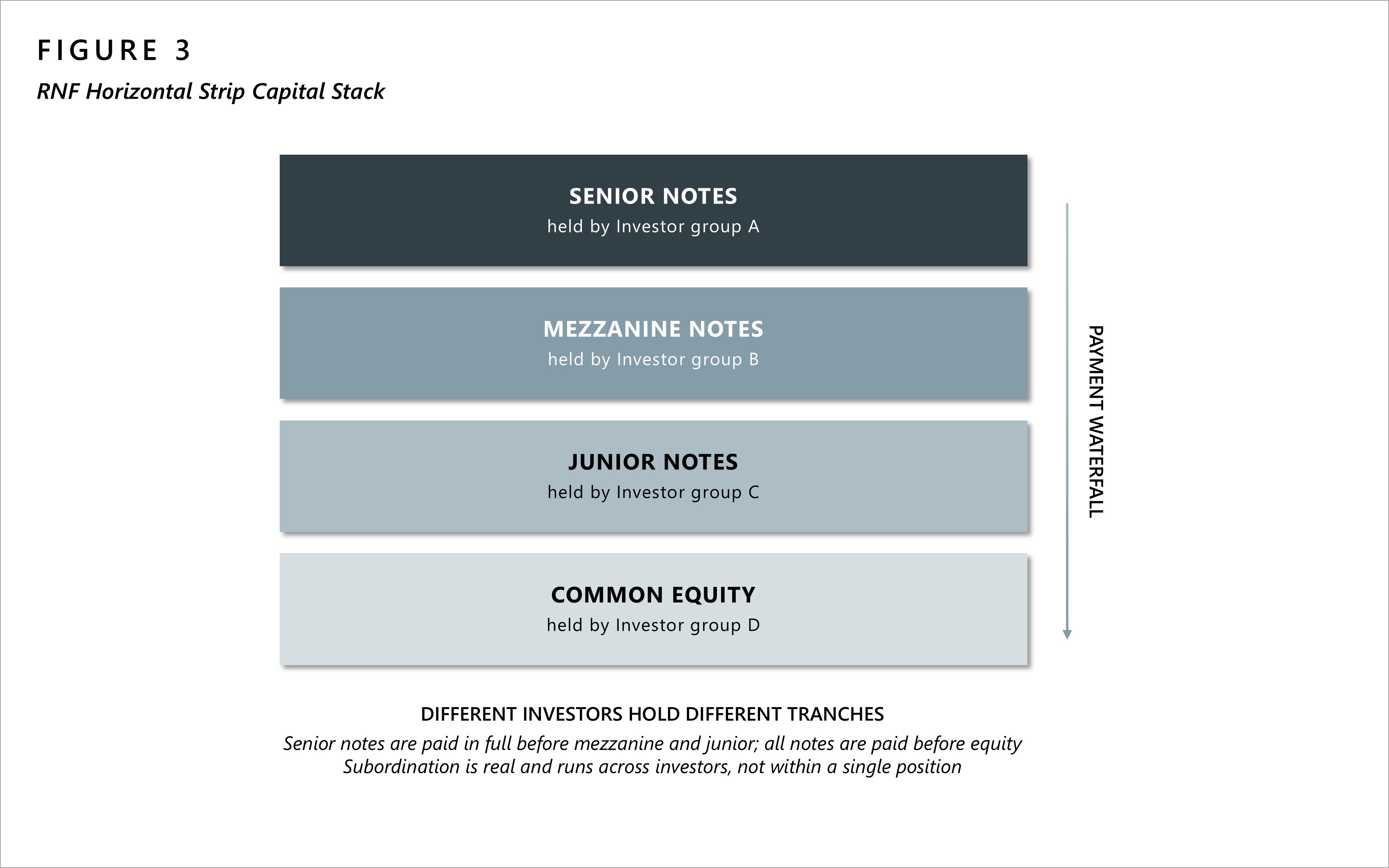
Horizontal strip RNFs (each, a “Horizontal RNF”) present a different challenge. These feeders typically issue senior, mezzanine, and subordinated tranches, with investors holding different tranches based on risk appetite, return targets, and, for insurance investors, regulatory capital optimization under the framework of the National Association of Insurance Commissioners (“NAIC”). These tranches represent fundamentally different economic positions: senior noteholders expect first-priority repayment and accept a lower yield in exchange, while subordinated noteholders take on more risk for higher returns and lower payment priority.
It is important to distinguish subordinated notes that function as the de facto equity of the structure (sometimes referred to as “first-loss” tranches), which sit at the bottom of the capital stack, absorb first losses, and represent the residual ownership interest, from subordinated notes that are junior debt, which rank below senior tranches but retain the characteristics of a debt obligation. The distinction matters for the structuring solution discussed below: a first-loss holder already occupies the residual position and loses little if its commitment is callable as common equity, while senior and true junior-debt holders require an equity instrument that preserves their bargained-for priority. Figure 3 sets forth a simplified Horizontal RNF capital stack.
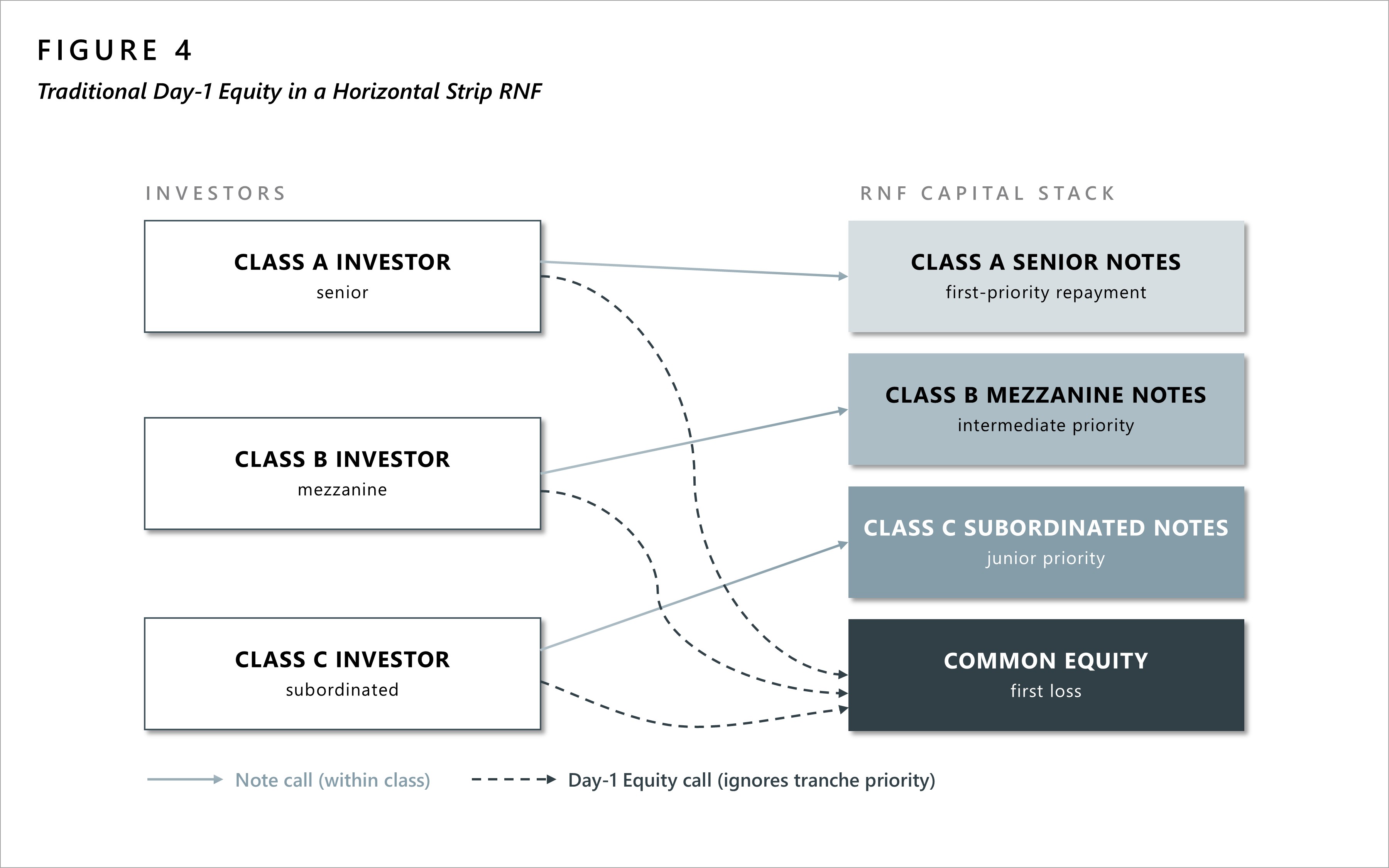
Investors in a Horizontal RNF typically hold only one note class and often lack an equity layer, so a common equity call does not align with their negotiated position. Applying unmodified Day-1 Equity collapses the negotiated waterfall if a capital call occurs on the Day-1 Equity, as the equity call does not respect tranche priority. Common equity sits at the bottom of the capital structure regardless of the investor’s note class. A senior noteholder that suddenly holds common equity exposure is no longer economically or structurally senior with respect to the equity it funds. In effect, a capital call on the Day-1 Equity subordinates the senior noteholder’s otherwise senior position and alters the economics of the transaction with respect to mezzanine and subordinated noteholders. Figure 4 illustrates the resulting distortion.
The Preferred Equity Alternative
Mayer Brown has developed an alternative approach that structures Day-1 Equity with the same tranche architecture as the debt. This approach, which is gaining market traction, uses preferred equity interests that mirror the economic hierarchy of the note classes, with clear subordination to any subscription facility indebtedness and robust waivers and protections for the benefit of subscription facility lenders.
For each class of notes the Horizontal RNF issues—Class A senior notes, Class B mezzanine notes, and so on—it creates a corresponding class of preferred equity interests with analogous priority. Each investor’s participation is structured as two separate commitments—a debt commitment and a preferred equity commitment—callable as a matching class of notes or, in the case of Day-1 Pref, as the corresponding class of preferred equity. Amounts funded under one commitment reduce the amount available to be called under the other commitment on a dollar-for-dollar basis, similar to standard Day-1 Equity used in vertical strip structures. Figure 5 illustrates the Day-1 Pref architecture.
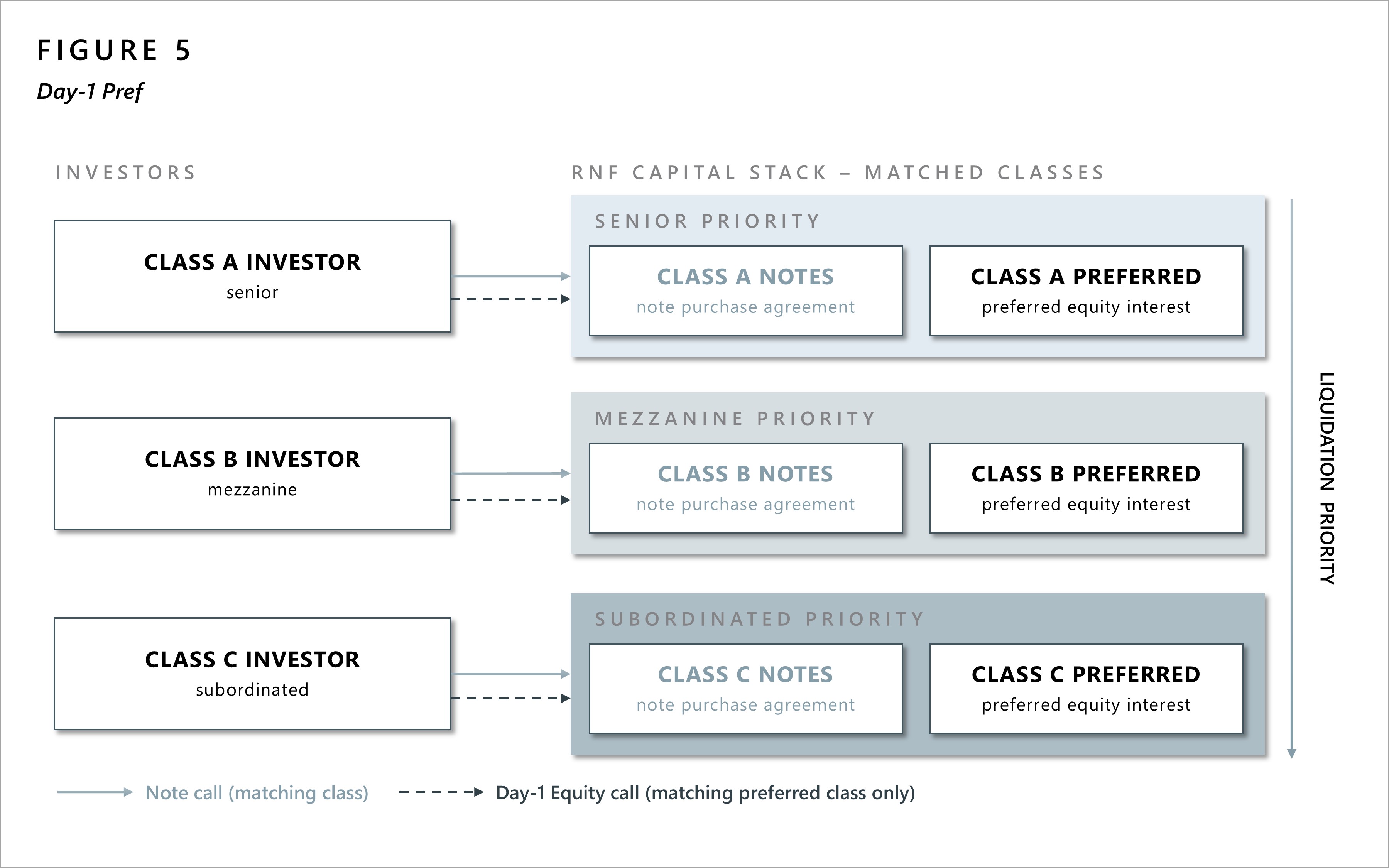
Day-1 Pref preserves the investment priority and realization waterfall negotiated by Horizontal RNF investors. A senior noteholder’s Day-1 Equity exposure is limited to senior-equivalent preferred equity, which sits above the junior tranches and common equity in liquidation. The investor’s economic position remains the same whether capital is called as Class A advances or Class A Day-1 Pref.
Day-1 Pref also preserves the flexibility identified in our 2022 Legal Update. The fund’s organizational documents can condition the equity call on the same triggers—whether an event of default under the subscription facility, an investor funding failure, or fund insolvency—ensuring that the equity leg functions as a remedial backstop rather than an everyday funding mechanism.
Implementation requires coordination across the suite of fund and credit documents, including the fund’s limited partnership agreement, the investor’s subscription agreement and side letter, the note purchase agreement, and the subscription facility credit agreement. As with any subscription facility-eligible capital commitment, the limited partnership agreement should establish an unconditional, irrevocable obligation on the part of each limited partner to fund its commitment, free from any right of setoff, counterclaim, or defense. For Day-1 Pref specifically, the RNF limited partnership agreement should also do the following:
- Define each class of preferred equity with distribution and liquidation preferences that correspond to the applicable note class;
- Grant the general partner the right to call, receive, and enforce the preferred equity commitments upon occurrence of the specified trigger events; and
- Expressly permit the collateral assignment of those capital call, receipt, and enforcement rights to the subscription facility lender, and acknowledge the lender’s status as an intended third-party beneficiary entitled to exercise them.
The Day-1 Pref structure raises a related question: could an investor facing an equity call argue that the preferred equity commitment should be recharacterized as debt to invoke Section 365(c)(2) protections?
In recharacterization analysis, courts weigh debt-like features (such as mandatory redemption, fixed maturity, enforcement rights, and security interests) against equity-like features (subordination to creditors, payment from legally available funds, and absence of creditor enforcement mechanisms). Day-1 Pref is designed to be treated as equity: it is a capital commitment, not a payment obligation; lacks fixed maturity and mandatory redemption; and is subordinated to creditors. Although preferred equity falls further along the risk continuum than Day-1 common equity, a successful recharacterization argument would require an investor to contend that the equity backstop it unconditionally agreed to fund should be treated as debt to avoid making whole senior creditors who relied on that commitment, which would be a difficult position to advance. Nevertheless, given the structure’s relative novelty and the fact-intensive nature of recharacterization analysis, market participants should evaluate it on a transaction-by-transaction basis.
Impact on the Note Ratings
A threshold question for RNF investors—particularly insurance companies whose NAIC designations turn on the rating assigned to their notes—is whether the Day-1 Pref structure affects the rating analysis. Properly structured, it should not. The rating on each note class reflects the likelihood of timely interest payments and the ultimate payment of principal on the notes. It is an assessment of the performance of the debt, not of the form in which uncalled commitments may be drawn. Day-1 Pref does not alter the notes’ terms, the payment waterfall, or the aggregate commitment supporting the structure. The preferred equity classes mirror the note hierarchy precisely, thereby preserving the subordination analysis underlying each rating.
Equally important, the equity-call right is typically exercisable only in remedial scenarios, such as an event of default, an investor funding failure, or fund insolvency. In these circumstances, the structure is already in distress and the equity call functions to protect note performance by ensuring that committed capital continues to flow. Because the rating focuses on debt performance, and the equity leg activates only to backstop that performance, the structure is ratings-neutral. Indeed, the structure may be ratings-positive as the existence of an enforceable equity backstop creates an additional incentive for investors to fund their debt commitments, even in scenarios where an investor might otherwise attempt to avoid its funding obligation by invoking Section 365 of the Bankruptcy Code.
For insurance company investors, this structure should preserve the NAIC designation of the notes and, if the equity leg is ever exercised, may improve risk-based capital treatment relative to funded common equity under a traditional Day-1 Equity.
If the equity leg is exercised, the funded amounts become preferred equity, which generally receives more favorable risk-based capital treatment than funded common equity under a traditional Day-1 Equity. This is an improvement for insurance investors. Because the preferred equity classes mirror the economic and priority characteristics of the corresponding note classes, and the equity call right is exercised only in remedial scenarios, the structure should maintain the analytical framework used by rating agencies and insurance regulators for Day-1 Equity structures. In this respect, Day-1 Pref should extend the benefits of the traditional approach to the more complex capital stack of a Horizontal RNF.
Subscription Credit Facility Market Takeaway
The Day-1 Equity approach remains the market-preferred approach to mitigating Bankruptcy Code executory contract risks that might otherwise steer lenders away from RNF borrowing base inclusion, but it is not one-size-fits-all. As Horizontal RNFs become more common, sponsors and lenders must incorporate the equity commitment layer with the same precision they apply to the debt tranches. Day-1 Pref accomplishes this without altering the economics. Each investor retains its priority position, the fund secures a borrowing base–eligible commitment through an enforceable and irrevocable equity backstop, and the structure preserves the subordination analysis supporting note ratings.
For lenders, the diligence is straightforward. First, confirm that the credit agreement’s borrowing base eligibility criteria expressly contemplate commitments subscribed at closing and callable as preferred equity. Second, verify that the collateral assignment of call rights captures the preferred equity leg, and not merely the note purchase obligation. By doing so, sponsors setting up Horizontal RNFs and lenders evaluating borrowing base eligibility can build this architecture from Day 1.
*With contributions from Joaquin De Baca, Sean Scott, Lawrence Hamilton and Jan Stewart.